Showing posts with label clean nairobi. Show all posts

Monday, 9 November 2015

Little Things That Matter


Nairobi may be clean in the CBD and in a few porsche estates but generally it is not anywhere close to being a sustainable city. Litter and waste materials are thrown almost everywhere in public spaces and streets. Efforts are being made on a daily basis to correct this, but the rate at which these efforts are made is way less than the rate at which waste is produced and discarded, making it only practical if we, Nairobians, begin to show concern for the waste we produce. More often than not, I tend to assume that we simply do not care, but maybe, it could be that most of us do not know how to keep our environment clean, and we need to be reminded constantly of what to do.

1. If you are a highly motivated person, you could volunteer your energy and ideas. Your dedication will be inspiring :) !!!

Sometimes back I read an article about The Ugly Indian (TUI), a movement of anonymous but self-motivated individuals who have taken it upon themselves to clean the streets of India without pointing blame fingers. These guys literary transform any ugly and dirty looking public space into something magical. They do not act self-righteous in any way, engage in moralizing conversations, or lay blames on the government for failing their part. They only identify a spot that needs to be fixed, come up with low cost but highly replicable ideas of fixing it, and then fix it.

Maybe we need the same kind of energy in Nairobi because I believe it goes a long way to inspire many people to do the same. We need people who do not hide behind social media making noise, but will be out there on the streets being the change they want to see. This is where you can come in if you are a highly motivated individual. There are numerous organizations where you can pour out that energy. Mazingira Safi Initiative (MSI) is just but an example. These organizations exist so you can meet like-minded individuals and put your energy and ideas to a more effective and impactful use.

Before we can begin to think of these highly motivated individuals who would freely volunteer to clear an illegal dumpsite, like the one in Guthurai Roundabout, without minding the mock of passers-by, there are many of us whose only source of motivation is money. We need to be paid first to show up in a community cleaning exercise or to mobilize people to fix a problem. Don't worry!! There's also a part you can contribute.

2. Be an ambassador where you are.

Unless you tell them constantly, children and also grown ups may not know

Many people are unaware of the unwritten rules. They do not see the problem the way you do. Therefore, be an ambassador. Take this as a commission to provide guidance to those who do not see the magnitude of this problem the way you do. I like what one individual volunteer of MSI once said,

“We need to be bold when you see someone litter. Gather confidence and tell them to pick it up".

This is practically what I mean, but of course you need to be nice and polite, not to stir up any emotions. 

Being an ambassador could also mean making noise on social media and sharing with your networks environmentally resourceful content that they can benefit and learn from. It could further mean educating your kids and small siblings, teaching them to be responsible at home, in school, and in any other public spaces.

3. DO NOT LITTER

Remember this article I wrote sometime back, Think before you toss? Well, I tend to be inclined to the perception that we bring upon ourselves, not entirely, the many problems that we face. Every socioeconomic challenge linked to poor waste and litter management can be blamed on us when we liter. So, try as much as possible to throw away waste in a dustbin. You can hold on to dry solid waste (because it’s dry) until you are able to get rid of it in the right manner. You can also have a paper bag, not necessarily plastic, to keep wet waste such as fruit peels, until you are able to dispose it off in a dustbin. Remember dumping is dumb. Not only is dumping aesthetically unpleasing, it often attracts more dumping as the pile of rubbish grows and then becomes a hazard.

4. Support recycling efforts

There is cash in trash. Ever heard of that saying? Apparently, it is true. There are companies reaping millions from recycling waste. I am not saying you get in the business of waste recycling, but maybe you could be wondering, what is my in role in this? How do I support recycling? Well, you could start thinking along the lines of waste segregation. Those clearly labeled litter bins in town for separating waste, don’t mix up waste in them. Put the right one in the right bin. A lot of the waste we produce, approximately up to 80%, can be transformed into something else for us to use rather than being left a menace to the environment.

5. Lastly, don’t quit, don’t settle!!! 

Humans have a way of starting well but not finishing well. Very few finish well, many give up on the way. I have been to a number of cleanups, and it is demoralizing when after you sweep an entire street, a local resident fails to appreciate your effort and decides to litter right where you have swept. It will therefore take resilience and that is what will take you back to that same street the next time to clean it up, maybe set up dustbins, and teach people what to do and what not to do. 

While Nairobians try to do all these on one hand, the government and other well abled institutions, on the other hand, are hopefully playing their part in putting systems in place that will see a lasting solution, because all these efforts have to be synergistic.

Thursday, 30 October 2014

THINK BEFORE YOU TOSS: MAZINGIRA SAFI NI JIRANI MWEMA

 The world is a very small place. It is supposed to bring us close, closer to people and closer to things. It is so small that we ought to be wary of what we say, what we do, and how we interact with even the least thought of things; lest one day we meet when we least expected it, at a place we never thought of, and in a form we could hardly imagine. An encounter that might not be pretty.
Recently, I was sited in class, and in one of those moments where dons just like to digress off topic, my professor asked an obvious question, considering his audience was purely postgraduate students. A question that least makes you to doubt yourself, because you watch TV, read the papers and books, and you attend forums that help you to connect many dots in life; but a question that crosses the mind of very few and even among the few, the question is rarely answered with actions but only left to linger in the cognitive domain.
He asked, “When you buy a candy and decide to toss away the wrapper carelessly, where do you think it goes? Do you ever imagine that the two of you might meet one day but this second encounter might not act in your favor?”
He was obviously hinting at something that is not new, and even as he tried to explain it further, he still left it open and made us to rationalize it on our own, typical professorship. But I tried to be objective and to put myself in the shoes of that candy wrapper or litter for that matter. I decided to write an epitome that embodies the larger reality about litter. I simply decided to bring litter into life, give it a human face, and present it as below.
A lot has been said about me, but the cycle never seems to end.
Stories after stories, nothing ever seems to change.
You leave me in places where I am not supposed to be left.
You drop me on the streets where council workers have just swept.
You toss me out of your car windows, by the road side to stench.
Even after seeing ‘no litter’ sign posts, your ignorance still remains at its best.
I may be disgusting and useless, what do you expect? I am waste.
What good can come out of me? I make a mess.
But just make sure you put in the right place.
I understand candies appeal to your tastes
When you are tired and hungry and all you want is to rejuvenate.
I understand Nairobi does not have enough bins
And you are always too anxious to get rid 
The burden of carry me around
I understand that picnics are fun, when you hold them in public Parks 
You get to share memories that last, for a while, 
But you forget to care for the trash, you leave behind.
I understand most Nairobi streets are dirty
But it’s only fair if you simply do the right thing
You slap Mother Nature right on her face 
when you litter or leave me on the ground.
It’s only a matter of time before she gets
 really mad and unleashes the wrath of an irate woman.
A scene my eyes will honestly hate
But even now, I loathe seeing you and your brood fall ill 
I loathe contaminating aquifers and river streams
I loathe making the air heavy for you to breath
I just loathe when I see you walk on dirty streets
Or see you sleep next to a pile of me
So, if you refuse to understand me
I will be your worst nightmare. Trust me.
If you ignore those litter bins,
Or if you think you are too far from a bin, 
and decide to compromise,
I will be your worst nightmare. Trust me.
Worst all, if you decide to cut down trees
thinking that I have nothing to do with it,
I will join forces to be your ugliest nightmare. Trust me
And that’s where we shall one day meet
But I want to save you a lot of trouble
Put me in the right place and your brood, please disciple
I also think you need to learn how to recycle
It’s a ‘no brainer’, and you are not splitting an atom
You are simply separating waste, something easy to fathom
So much for being in the shoes of a candy wrapper, but if litter was to think like this and everyone understands it, there would be a lot of justice on the streets of Nairobi. Nairobians would operate on a different tier. A tier of kusema na kutenda, for Mazingira Safi ni Jirani Mwema.

Friday, 18 July 2014

BUILDING THE "MSAFITE" MOVEMENT


The notion of volunteerism is often seen as a tool for peace and development. This is mainly due to its benefit to the individual volunteers and the contribution it makes to the peaceful coexistence of people within communities and the development of societies. Volunteering opportunities, especially at community level, tend to bring people together to work in solidarity towards addressing issues and challenges affecting communities. They are a way of giving back responsibly and adding value to community projects. But volunteering is also a major driving force for environmental sustainability and protection of natural resources. 

Since August 2013, Mazingira Safi Initiative has made significant strides towards building a community based waste management system in Nairobi and inspiring communities to take up the responsibility of cleaning their environment. The initiative is just one powerful example that exists in different parts of Kenya and the world at large of people uniting and mobilizing action through volunteerism to address the challenges of litter, improper waste disposal, and individual attitude against environmental cleanliness.  Just like the greenbelt movement, which, through the power and support of volunteers managed to empower communities, especially women in communities, to improve their livelihoods by conserving the environment, the initiative is using the power of volunteers to gradually building a strong movement of “clean freaks”, also known as “msafites”. These are individuals from all walks of life who are radical about the cleanliness of the environment.


A movement is comprised of radically minded individuals who are brought together by their desperation to be the change they want to see. History has it that movements can bring down outdated systems, overthrow poorly run governments, and caused terror among those in opposition to positive change. If the combined effort of the ever growing 1000+ "MSafites" is well facilitated, then this will not only support the attainment of environmentally sustainable outcomes but also promote a long lasting process that changes people’s attitudes and perceptions towards the environment and encourage resilience towards realization of change.  Volunteering is a critical driving force that will continue to build the “Msafite movement”. 

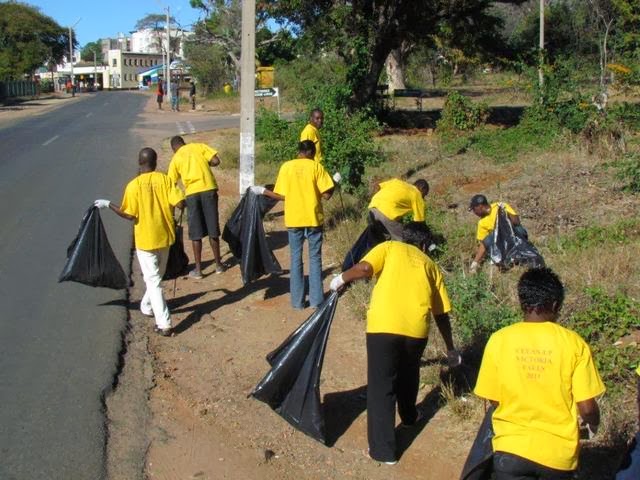
Volunteers during one of the MSI's cleanups


All Kenyans should be part of this new wave of clean freaks and give first priority to the environment and the well-being of people before anything else.  Without sustainability, problems such as poverty can never end because pollution, uncleanliness, and environmental disasters deeply affect the poor. Supporting and encouraging each other to be environmental ambassadors in our most immediate environment, puts us in the right path towards achieving sustainability. What Nairobi and the whole of Kenya needs, is msafites and like minded individuals to mobilize resources to ensure that the streets, neighborhoods, towns, and markets remain clean.


It takes our collective effort to ensure streets remain this clean.
Article written by Kelly Wale

Wednesday, 21 May 2014

LET'S NOT BE COMPARED TO CANCER!!!

I recently came across a very thought-provoking comment posted on the internet. This is what the writer, Agent Smith, wrote: I would like to share a revelation that I have had. It came to me when I was trying to classify your species. I realized that you humans are not actually mammals. Every mammal on this planet instinctively develops a natural equilibrium with the surrounding environment, but you humans, do not. You move to an area, and you multiply and multiply, until every natural resource is consumed. The only way you survive is to move to another area. There is another organism which follows the same pattern. Do you know what it is? A virus! Human beings are a virus, a cancer.”

Now, for a person to sit down and think about this and then transfer all his thoughts onto a webpage, he must have either experienced the wrath of our fading environment or was knowledgeable enough to know we are sitting on a time bomb. Agent Smith compared us to a virus, a cancer. These are the worst form of life-forms to ever exist. In my opinion, we are worth being called viruses and cancers. Like many other cities of the world, Nairobi is a city that is dull and full of slabs of concrete on every corner. A city with little green yet our national flag bears the green color. Who is to blame?

Our country is very busy growing steadily in every sector and poorly environmentally. We are experiencing a construction boom yet no nature boom as we go along. Are we doing this out of ignorance of the danger the environment is facing or out of selfish ambitions? Are we climbing the ladder of economic success while stepping carelessly on the head of the environment?

A day is coming when the sun, the trees, the waters, the soil and the wind will gang up against us. It will not be a battle with a hope of mediation. It will be one where humans will cry for mercy. We will sit and soak up the hot sun until we can’t anymore. Our throats will be on fire because we will have no water to drink. We will one day be sitting in the comfort of our big mansions, watching on our big flat-screen TV, news and images of malnourished human beings yet with all the money we will have acquired with our development, there will be no food to buy.

It is time we stop behaving like viruses and cancer cells. It is time to stand up and fight for this precious part of us that just keeps on giving while we give back nothing, time to give environmental issues the attention they deserve, time to take the environment as serious as we take politics. It may be a long shot but every journey starts with a single step. For example, stop littering with the wrapper from your sweet or PK! Thought-provoking, isn’t it? Think about it then act then tell your friends.

Tuesday, 11 March 2014

Eyes Set on the Big Picture for the Founders of Mazingira Safi Initiative


“The journey ahead is going to be a tough one, but we are dedicated to it”. These are the sentiments shared by the two founders of Mazingira Safi Initiative as they pose next to a pile of waste waiting to shoot a scene in their next campaign video.

The two founders, Purity Wanjohi and Kelly Wale, recall a moment when they randomly approached a German tourist at a popular cafeteria in Nairobi to share the idea of the organization. The conversation went well but concluded with a daunting statement from the tourist, “It is a good thing that you two are doing, but just know that it will be impossible to achieve the dream”. If anyone was to ask why the two are still committed to the organization after receiving such a response, they would point to the big picture. They had a choice to give up right there, but they understood that dreams are only validated by God.


Wayne, Purity, and Wale

As Kenyans, we cannot be oblivious to the environment; it is a terrible thing to ignore. Whether you belong to the social elite, the middle class, or you are simply a ‘Wanjiku’, the responsibility of caring for the environment does not belong to some government agencies or foundations.
Engaging communities in cleanups to increase environmental awareness
The environment is a responsibility of everyone. This is the big picture that the founders of Mazingira Safi Initiative have set their eyes on. It is a picture where Kenyans no longer litter improperly not because of any heavy penalties or fines that might be associated with it, but because they understand its effect to the environment and to their own lives.


It is a picture where there are working structures for effective waste management in every urban center in the country. It is a picture where the amount of waste that goes to dumpsites is reduced by separating the recyclable wastes from the non-recyclable wastes at source. It is simply a picture of a safe, secure, and clean environment.


Organic waste make such good manure

There are a lot of people at stake when we don’t take care of our environment not just in the present generation but also the future generation. The environment was not given to us by our forefathers but rather it has been lent to us by our great grandchildren.


Waste glass bottles are recycled in some of the most beautiful and artistic ways